This is the webpage of a group whose aim is to improve the kit and clothes of a UK seventeenth century Civil War reenactment group, using the most up to date references and research. Feel free to comment on any of the subjects raised here and return often as I want to keep the discussion lively and ongoing.


Please look at the extra tabs on the right hand side. The newbie section is the place for basic kit if you're just beginning to reenact the 1640s. Haberdashery has lots of detail about colours, buttons, tapes etc.

Thursday, 24 March 2011

Shirt in the Manchester City Galleries of Costume

There aren't many shirts left in existence from our period, let alone relatively basic ones, but this is an exception. It's kept in the Galleries of Costume in Manchester. Not sure how it survived, but reading the description the owner who brought it to the museum didn't know what they had! Stuart Peachey has published a pattern based on this shirt in his book "Common Soldier's Clothing of the Civil Wars". It shows how a shirt could be cut from a standard 10 foot length of linen.


This is the description from the Museum:

"Long full shirt in white linen. Cut in a T-shape: 2 large panels with side seams; separate sleeves set into the body and forming small underarm gussets. Sleeves and body drawn into bands at cuffs and neck with very fine, close smocking. Very fine French knot embroidery worked along upper shoulder seams. Openings at cf, side vents and cuffs, all edged with narrow bobbin lace (distressed). End of each opening marked by a knot-motif in plaited applique braid. Other seams very finely double over-stitched. Falling-collar attached at neck of fine Flemish (or Northern European) bobbin lace (4 inches deep) with shallow scallops at edge and a close formal geometric design. Embroidery is of a higher quality than the lace, and body of shirt almost certainly earlier, perhaps mid 16th century, with later lace collar added.
Purchased at auction in 1995 with 50% aid from V&A/MLA purchase fund. The vendor brought a pair of stays to be valued for sale, and this shirt was used as wrapping or a cover which is how it had survived."

Thanks to the Manchester City Galleries for permission to reproduce this image.

Tuesday, 22 March 2011

Cloaks, Coats, Cassocks Etc.

On the face of it, a soldier’s coat is exactly that, a coat or overgarment. However in many pictures it is obvious that another layer was used. Although 17th century folk were a hardy bunch and extra layers may have been looked on as a luxury item, this was a rather cold time to be in England and the summers of the early 1640s were particularly wet ones too. Picture on the right portrait of Jan Six by Rembrandt.

The civilian answer to this was the cloak, cut out of a circle or part of circle of wool. The simplest form was just that. An example came to light in an excavation at Dungiven Bog  in Ireland, amongst other early 17th century clothes found is a semi circle of wool cloth designed to be worn over the shoulders. This reproduction was made by Gilly Morley.


A more upmarket cloak had a square collar that could stand up when the cloak was fastened and lay flat down the back when worn open. Engravings of crowds from this period show that this type of cloak was a very common garment in the city during the winter.


Many soldiers, particularly those impressed from the towns and cities, would probably have one of these cloaks. They were practical and could act as a blanket  at night. It is thought that tents were not used on campaign and something to cover yourself up with if you hadn’t found shelter would be a sensible thing to own. Maybe blankets were worn as cloaks too, though after a few months in the field it would be difficult to tell whether it had started out as a cloak or a blanket. These pictures, the one on the left by Hollar, and the other, below of a French army besieging a town in Flanders from the 1650s show this clearly.


Common working men also had a basic long loose fitting coat, bit like an old fashioned mackintosh, commonly described as a gaberdine or just called a coat. This picture of a huntsman by Dutch artist Joachin van Sandrart


Also worn by more affluent civilians and higher ranking soldiers was a larger more complex coat, known as a cassock. There were many variants and several different names and spellings. It seems to have developed from an overdoublet and was in our period generally thigh length with large sleeves and turnback cuffs often displaying a facing material of contrasting colour.  This recent example was made by Barbara Robinson.


A popular item with reenactors, although it doesn’t appear very often in illustrations is a cassock with sides and sleeves that can be open or buttoned up, giving a garment that can be worn in several styles, cloak, coat or coat with hanging sleeves. It doesn’t appear in any documents, although there is a reference to coats being made for the Earl of Essex’s guards that specify 180 buttons per coat, which was probably for this type of coat.  Nice example here in a detail from a painting by Hendrik Pot.


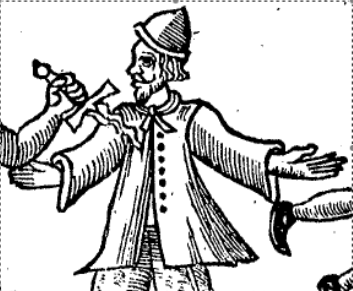
Sleeved cloaks were also worn, a kind of cross between a coat and a cassock that were worn in a casual ‘off the shoulder’ fashion with the sleeves being no more than decoration. This rather rakish individual appears in several Roxborough ballads.


As Tony Barton wrote in 'True Relation': You might attempt reconstruction of any of these garments, depending on your chosen role. A pressed labourer would not possess a buttoned cassock, but he might have a simple overcoat of grey with a few cloth buttons. An old buttoned jerkin might be appropriate for a veteran soldier; a bourjeois would wear a cloak, sleeved or not, the officers have free choice-gold-laced sleeved cloaks, buttoned cassocks, or whatever. 
If you want to look really low life, take an old grey army blanket, tow it behind the car for a few miles, bury it in the garden until the spring, dig it up and wear it. You'll look lovely.

Monday, 7 March 2011

Aprons (any strings attached?)


Women of almost every degree in society wore an apron indoors and outdoors. It was a simple functional garment that was sufficiently common to become proverbial: ‘tied to her apron strings’ for example. It protected the more expensive, less easily washed and dried, petticote (or skirt) and also provided a quick, always available cloth on which to wipe your hands. Photo on the right by John Beardsworth.
Status in society seems to have had no bearing on whether you wore one, except in the quality of the aprons worn. Inventories and wills from relatively lowly households suggest that most women had one or more of probably three grades of apron, suited to the task and situation: old ones for messy jobs,  (scrub the floor, pick up hot pots, gather eggs etc.), a newer one for normal wear (going to market, meeting the neighbours), and a ‘Holy day’ apron which could have been quite elaborately decorated – the ‘Sunday best’.
The apron was normally linen, wool does not seem to have been used. Linen is easy to wash and dry, whereas wool is not, especially in cold, wet weather. Mary Champian (picture left) will find it much easier to get the blood out of her apron than her petticote. A greasy apron is a potential deathtrap around open fires, so frequent washing was important. For the same reason the speed with which the apron can be torn off if it starts to smoulder/burn is important, so complicated fixings are probably not authentic. Simple apron strings tied behind the back, or even just a couple of brass pins to the petticote could be used (but remember you may need to remove it quickly).
The apron itself should be a linen rectangle wide and long enough to cover most of the front of the petticote. It should be hemmed on all sides, and is easier to clean and press if it will lie as a flat rectangle, so one with permanent gathers at the top is likely to have been considered a nuisance. The apron will lie better if the strings are attached an inch or so in from the edge rather than directly to the corners. It is possible that some of the ‘gathered’ aprons seen particularly in Dutch paintings (see right) reflect an apron-string passing through the upper hem rather like a curtain on a cord. Remember that more material than was absolutely needed served no useful purpose, but pushed up the cost.
Linen in the seventeenth century could be bleached white with exposure to the sun but would never become as white as that achieved using modern detergents. It’s much safer to pick an off white shade, especially if you intend to portray a common person.
Holy day aprons were probably normally decorated in some way appropriate to your social station. Simple applied decoration inside the edge is possible; in other cases a grid pattern of horizontal and vertical ribbons or tapes (or perhaps even something woven into the fabric); drawn thread work may also have been used. This was for special occasions so the apron was carefully preserved and protected. It is unlikely that such aprons would have been used around a soldier's camp except for church service or a wedding.


So to summarise:

All women wore aprons as part of normal everyday daytime clothing.

Wealthier women wore an apron, although theirs were of finer quality.

They probably had more than one apron.

The simplest apron is a flat rectangle of linen, plainly hemmed, covering the front of your petticoats but not wrapping round the sides, and reaching from the waist to just above the hem of the petticoat.

Decoration can be added according to your station in life (fancy stitching, drawn thread work, hem-stitching, etc.).

Finer materials and decoration would be for women of higher status gathering at the waist would use more fabric and therefore cost more, so would be another indication of wealth

Friday, 25 February 2011

Prince Charles dressed as a countryman

Just found this picture. It's not exactly contemporary but probably painted not long after the event. It's one of a series painted by the artist Isaac Fuller and depicts Charles II during his flight from the Battle of Worcester in 1650. He's just putting on a disguise and all the clothes show exactly how a common workman would have dressed. There is also a written description of his clothes, so we know he's wearing a hat borrowed from a miller: "greasy old hat with the brim turned up, no lining or band". Breeches are coarse and threadbare "even to the threads being worn white", the doublet is an old sweaty doeskin one with a high waist and tabs. His shirt was old, "patched at kneck and cuffs made of the coarsest hemp". The stockings are old green ones worn and darned at the knees and cut off at the foot and heel. His footwear is a pair of long boots.


In the second picture he is attended by two obsequious looking individuals in patched coats. Are they creepy enough I wonder to not mention that their future king has forgotten to button his fly?

Monday, 21 February 2011

Knitted Caps (or Hats!)


It is obvious from printed accounts and inventories that woollen hats were a common item of headgear in the 17th century. What they looked like or how they were made is a subject of hot debate. There are few obvious images of knitted caps and no actual dated examples remaining. One hat worn in this period has become known as the Monmouth cap and was knitted in wool, mainly in the Monmouth area but later also in Bewdley and heavily felted. There are two possible designs, one is like a skull cap, or modern beanie hat and the other, based on an example in the Hermitage museum St Petersburg which belonged to Peter the Great and may just have been made in this country and exported has a higher crown and a rounded brim.  This nice example below left is by Gloria of Historical Caps. Her website can be reached here.


John Foxe (above right) is wearing what looks very much like a knitted hat with a brim in this woodcut from 1641. Although he died nearly 100 years earlier, it's a good assumption he's pictured in clothes contemporary to the Civil War. Note the characteristic drooping brim. It is quite possible, although by no means provable that many wide brimmed hats in woodcuts, especially those with drooping brims could actually be a knitted Monmouth


There are several illustrations that show a skull-cap type knitted hat being worn by soldiers. This poor sailor being done in by an "East India Devil" is wearing what looks like a knitted cap turned up at the brim.


This second type is much the smaller, lighter affair and would have fitted quite nicely under a helmet. The classic design has a small bobble on the top and a loop at the bottom edge, possibly for hanging up, or to secure inside a helmet. The doubled up ribbed edging at the lower end of the cap can be turned up or not as you fancy. The example in Monmouth museum has this double thickness of knitting at the edge and weighs in at 4oz in old money.  However this much represented example (picture left, courtesy of Nelson Museum in Monmouth) was unrecorded before 1930. Experts generally agree however that this probably quite accurately represents the cap that was turned out in the thousands by makers in this part of the country from the sixteenth century onwards.

There are very few images of Englishmen wearing knitted caps. This picture is by a Flemish painter from the early 1600s called Adriaen Brouwer shows a pipe smoker wearing what looks very much like the skull cap type monmouth with a felted wool crown and a bobble on top.

An inventory of caps sent to Ireland indicates that the Monmouths for military use were much more substantial, as they would have weighed in at more than a pound each. Stuart Peachey has conjectured that these caps would have to be the brimmed and crowned version to get anywhere near this weight.


There is also a variation in this design that may be a cross between the two, or some sort of middle ground, a knitted cap with a small brim that flows into the crown, shaped like a bluebell.


This guy being berated by his wife in the popular broadside entitled a Statute For Swearers and Drunkards from 1624 seems to be wearing either a light monmouth or a stocking cap with a small tassel.


Another type of cap particularly favoured by sailors, but also possibly worn by soldiers was the thrum cap. Knitted with thrums, or loose ends of yarn, the cap has a shaggy appearance and is very warm to wear. This example was knitted by Sally Pointer. She supplies instructions on how to make this and several other types of cap on her website.


Photo on the right by Rusty Aldwinckle and at the beginning by John Beardsworth of knitted caps being worn by London Trayned Band at the Tower of London and reenactment at Basing House. Below classic monmouth by Historical Caps.


And the difference? A cap touches your head in all places whereas a hat has a raised crown. No need to worry anymore!

Friday, 18 February 2011

Cover Your Head Sir!


Seemingly the most popular hat in 1640s England was made from felt with a wide brim and a high crown. Most of the images and woodcuts show this kind of hat being worn everywhere and by all walks of life. There were several variants however. The raw material could vary from processed beaver fur, which produced the best quality hats to the waste product from wool broadcloth production. The wool or fur was broken down into its constituent fibres and then felted to produce a kind of fabric version of fibreboard. This was then shaped with steam over wooden blocks and set with glue to produce a stiff hat. The blocks were generally circular rather than oval, so that once they'd been worn for a while the brim would take on the typical curve seen in pictures as the crown became shaped to the head of the wearer.

There are many woodcuts that show a hat with a wide brim and high crown being worn by soldiers and several extant examples in museums so we can be pretty sure that this is a good hat to wear for 17th century use. 


Sometimes it seems the brim can be turned or pinned up, possibly to avoid contact with a shouldered weapon.
They came in a variety of colours, white, grey and black being mentioned in references and would probably have had a band on the outside. Several images seem to indicate this.


This workman's hat with the brim pinned back is slightly earlier than our period but is a common style. It was found at a dig in Morgans Land Southwark. 'Copyright Museum of London 2011'


There is no reference to felt hats being an issue item to soldiers, but as they were such a common item we can probably assume that they were worn in the armies.


Photo by John Beardsworth, original hat courtesy of the Museum of London

Wednesday, 9 February 2011

Breeches (well trousered sir)?

The breeches worn in the civil war were generally of a different colour of to that of the coat. Unless you were in the Oxford army, breeches were not issued as part of the uniform. One possible exception would have been Trayned Bands who would provide their own clothes so may or may not have coat and breeches to match. Most troops would wear what was termed "sadd" coloured breeches, dull natural hues such as grey or mud brown.

The cut of 1640s breeches was full, though this was always down to how much you could afford to spend on fabric. Issue breeches would have probably been less full to cut down on material. They were of wool broadcloth, high waisted and reached to just below the knee. The waist band was narrow and the fly fastened with appropriate buttons. The pair on the right are fastened with a lace at the waist, though a button can be used too. The cloth of the breeches would be gathered, hemmed and stitched to the edge of a finished waistband, rather than turning the band over the gathered fabric and stitching down what becomes something like a wool sausage. An opening can be left in the rear of the waistband to accommodate a lace that can be used to adjust the fit of the garment.

The legs are either left open (unconfined), which was the latest fashion, or gathered and stitched to another band in the same fashion as the waistband, which could be secured with buttons or ties threaded through eyelet holes at either side of the opening. There is also some picture evidence of breeches legs gathered below the knee with no fastening at all. A ribbon or lace passing through and gathering the band is not period and is a modern reenactor-ism as far as we can tell. Breeches are generally lined throughout with natural linen to make them more comfy.

Pockets were inserted into the side seams and could be quite large with several compartments. They can be made of linen or leather.


In this period neither belts nor braces were used to keep your trousers up. Authentic methods of keeping your dignity include: buying a pair that fit, using hooks & eyes or string loops attached to the breeches that fasten to your coat. The grey pair by Gilly Morley above have strings, whilst Mr Marriott on the right has hooks that engage with the eyes in his doublet to hold them up.


Photos from Tom Aldwinckle and Chris Thomas. Detail on the right from A Letter To Mr Marriott, pamphlet from 1652