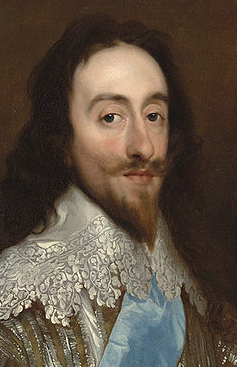
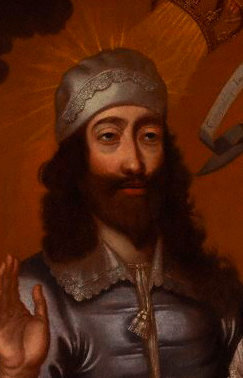
I wanted to post these two images because they show quite nicely the details of two shirts from the period, something you don't often see in Seventeenth Century portraits. Both paintings are attributed to Thomas de Critz the Flemish artist, sometime between 1648 and 1652, though the dates are uncertain.
The first shows John indoors, posed beside a skull upon which is a luxuriant growth of moss which was at the time thought of as a particularly effective medicine when powdered up and used for nosebleeds. John was a advocate of skull moss, maybe he grew it in the darker corners of the garden. John was for a time keeper of the King's gardens at Oatlands Palace near Weybridge.
Anyway, back to the point. John is wearing his doublet or cloak off the shoulder and is revealing a high quality shirt with what appears to be an integral collar rather than a falling band with some nicely worked lace which appears to run around the band but also continues down the front opening. This was quite unusual as this sort of decoration would not be seen if the shirt was worn in the standard way under a buttoned up doublet. Perhaps it was an indoor shirt?
The second image shows John in a garden in another shirt, a much plainer example with no lace or falling band attached. He's also wearing a fur lined coat which presumably is to keep him warm as he only has his shirt on underneath. Notice the front opening extends almost as far as his navel. This is a standard sized opening on all the extant shirts in museums, although it seems rather uncomfortable for modern wearers but usually the opening was tucked away inside a coat or doublet. There should be two ties or strings at the top of the opening but they are either missing or lost in the detail of the painting. It's not possible to tell from the picture, but I suspect that his cuffs are not gathered tightly, otherwise he would not be able to roll them up quite so expansively.
This is the webpage of a group whose aim is to improve the kit and clothes of a UK seventeenth century Civil War reenactment group, using the most up to date references and research. Feel free to comment on any of the subjects raised here and return often as I want to keep the discussion lively and ongoing.
Please look at the extra tabs on the right hand side. The newbie section is the place for basic kit if you're just beginning to reenact the 1640s. Haberdashery has lots of detail about colours, buttons, tapes etc.
Tuesday, 24 January 2012
Thursday, 12 January 2012
Stand By Your Girdlesteads!
Odd title I know, but I liked the pun.
In the 17th century a girdlestead was basically the line of the waist of a doublet, but could also refer to the inside of the doublet where a line of metal eyes would be sewn in, especially if it was part of a suit of clothes with a pair of breeches. For many years, the accepted way to wear a suit, especially in the Elizabethan era and early 17th century was to lace together the two with ribbon or cord points. These passed through thread worked eyelets that lined up together between the waistband of the breeches and the doublet. This is what's going on with Charles's suit here when he was painted by Muytens in 1631.
In the times before it was acceptable to use a belt for keeping your breeches up or braces being invented, this was the way to stop them falling down. Is the 1640s however this had developed into metal eyes sewn to the doublet and matching hooks on the outside of the waistband of the breeches. John Belasyse painted by Gilbert Jackson in 1636 has no obvious external ties joining his doublet and breeches.
At first sight, from the perspective of the 21st century this seems to be one of those stupid fashions that flies in the face of practicality. At Shakespeare's Globe for instance it quickly became apparent in their original practice productions that fast costume changes are not possible in a properly laced doublet and breeches. A large pair of scissors was their solution. Photo on the right shows a detail from a reproduction doublet from the early part of the century. However joining the two had been used for centuries and hooks and eyes were used for a long period in the 17th century, up until the fashionable doublet became so short that there was a gap between it and the breeches to show off the shirt ruffles. Such a long tradition must indicate that this is a practical way to wear clothes.
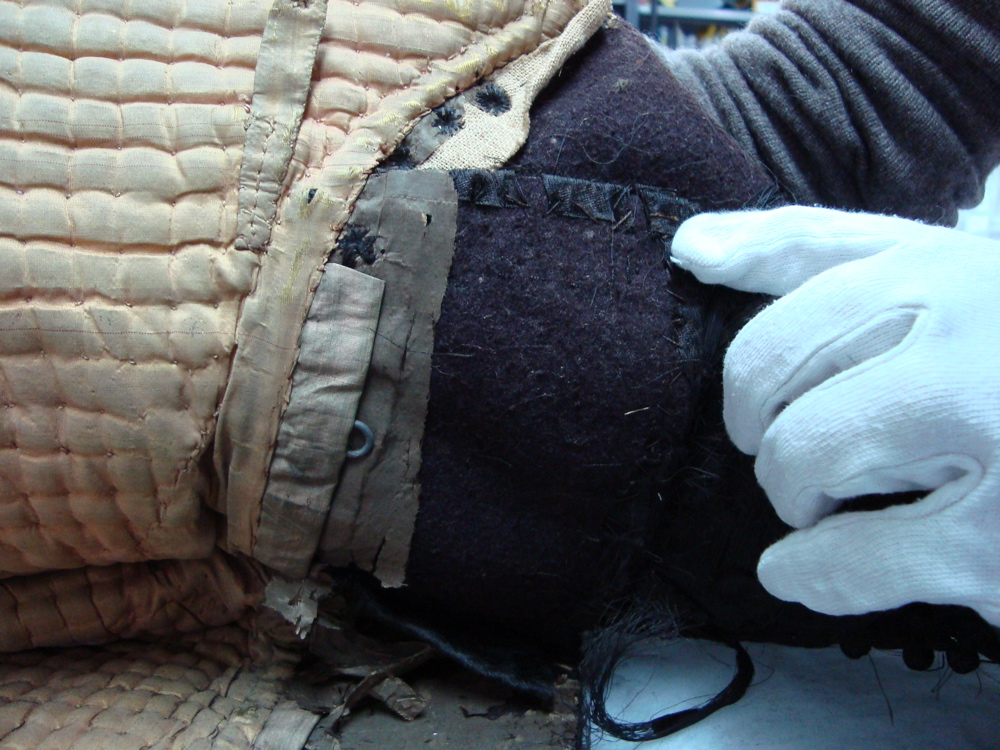
Several of the surviving doublets in museums have eyes sewn to the inside of the waistband. The Boy's Doublet in Abingdon for instance has two metal loops remaining in the waistband and the dark Isham one in the Museum of London (pictured) has eyes all around the waist. It's obvious from this that all classes, from ordinary boys to lords wore suits connected together with hooks and eyes.
In a pamphlet from 1652 entitled "A Letter To Mr Marriott", the famous London lawyer is lampooned for his gluttony and apparently other salacious practices from the front page picture. What you can see however from the breeches around his ankles that if he had wished to keep them up, he would have hooked them into his doublet.
I'm not sure however how far this practice was carried out during the Civil War for those serving in the armies. There is no mention in any records of hooks and eyes being purchased for soldier's suits, whereas things like buttons are listed frequently. It would also be tricky if you had your own breeches to get an issued coat with eyes that matched the hooks. who knows, as there is no evidence either way we can't tell. However as I have related, it was something that a lot of men were used to, so maybe they went out of their way to customize their clothes. It would make a kind of sense.
In the 17th century a girdlestead was basically the line of the waist of a doublet, but could also refer to the inside of the doublet where a line of metal eyes would be sewn in, especially if it was part of a suit of clothes with a pair of breeches. For many years, the accepted way to wear a suit, especially in the Elizabethan era and early 17th century was to lace together the two with ribbon or cord points. These passed through thread worked eyelets that lined up together between the waistband of the breeches and the doublet. This is what's going on with Charles's suit here when he was painted by Muytens in 1631.
In the times before it was acceptable to use a belt for keeping your breeches up or braces being invented, this was the way to stop them falling down. Is the 1640s however this had developed into metal eyes sewn to the doublet and matching hooks on the outside of the waistband of the breeches. John Belasyse painted by Gilbert Jackson in 1636 has no obvious external ties joining his doublet and breeches. Several of the surviving doublets in museums have eyes sewn to the inside of the waistband. The Boy's Doublet in Abingdon for instance has two metal loops remaining in the waistband and the dark Isham one in the Museum of London (pictured) has eyes all around the waist. It's obvious from this that all classes, from ordinary boys to lords wore suits connected together with hooks and eyes.
In a pamphlet from 1652 entitled "A Letter To Mr Marriott", the famous London lawyer is lampooned for his gluttony and apparently other salacious practices from the front page picture. What you can see however from the breeches around his ankles that if he had wished to keep them up, he would have hooked them into his doublet.
I'm not sure however how far this practice was carried out during the Civil War for those serving in the armies. There is no mention in any records of hooks and eyes being purchased for soldier's suits, whereas things like buttons are listed frequently. It would also be tricky if you had your own breeches to get an issued coat with eyes that matched the hooks. who knows, as there is no evidence either way we can't tell. However as I have related, it was something that a lot of men were used to, so maybe they went out of their way to customize their clothes. It would make a kind of sense.
Tuesday, 3 January 2012
Beards Old and New
I have a theory which I shall back up with images that the older you were in the 1640s, the more facial hair you had. Most of the pictures I've posted here are details from portrait painters of the period, notably Dobson, Walker and van Dyck, though there are a few others. I've kept to those sitters who can be reasonably accurately aged and portraits for which I can capture a decent sized image.
It may be that on campaign it was difficult to keep the standards shown here, but as an officer, a clearly marked fashionable beard or moustache would have served to mark them out from rank and file
First up is the Earl of Sandwich painted by Walker. He's 25 and has the merest smudge on his top lip.
These guys, Richard Lovelace on the left and Thomas Killigrew below right were both about 28 when captured for posterity. Yet again, whether or not they could grow any more whiskers, both have seemed to opt for a top lip subtle moustache look.

Both Thomas and Richard were royalists but seem to have taken very small parts in the course of the war.
Charles Cotterell at 30 years of age. Good growth of moustach on the top lip. Painted with Dobson in Oxford. Cotterell served in the armies.
Richard Neville by Dobson at 30. First appearance of remaining whiskers below the bottom lip in this list.
Spencer Compton, possibly a bit later than the first Civil War, but another subtle mo' sported by this 30 year old Royalist.
Henry Stone at 32. Nice mo' and that spot under his bottom lip. Stylish. He was a sculptor and seems to have missed the war completely.
Richard Willis at 32 also. Small underlip growth and what would come to be known as a Cary Grant on top. Looks rather superior doesn't he?
Thomas Fairfax, Black Tom from Yorkshire. One of the best parliamentarian generals and well groomed in the beard department. Tom has a neat, square cut goatee, getting slightly larger as he gets older I assume. Tom is 33 in this portrait as far as I can work out.
William Dobson on the left was 35 when he painted himself. Small underlip thing going on here. William Ireton (39) on the right however has a full set coming up, though moustache and square goatee, like his friend Fairfax are still quite defined in this portrait by Walker. Maybe this was Henry after a week on campaign?
Oliver Cromwell seems to have a small moustache and tiny lower lip beard. He was 45 I think when Walker painted him here .

John Lord Byron below was also 45 when painted by Dobson. Nicely sculpted whiskers above and below the mouth.

Conyers Darcy at 52. Beginning to opt for something that covers at least part of the chin. Conyers was a nobleman who spent most of the war in the Houses of Parliament.
Endymion Porter painted by William Dobson at age 56. As above, the large goatee covers part of his chin. Endymion seems to have spent large parts of the Civil War at the King's side, though it's unclear whether he fought at all.

Nicholas Lanier, also painted with Dobson at 57 years of age. Big moustache and accompanying goatee beard. He was a musician at the court in Oxford.
Two guys aged 65. Inigo Jones has the full set of whiskers and Sir Thomas Aylesbury a decently (for his age) wide goatee covering his chin. Aylesbury was a Royalist and patron of mathematics. See comments below.
Finally a selection of images of Charles that show his facial hair as it changed over the years, from the well groomed King in 1630 to the image of the martyr with a full beard in 1649. Interestingly he seems to have plumped for a rather distinctive pointy style that no one else seems to have copied.
It may be that on campaign it was difficult to keep the standards shown here, but as an officer, a clearly marked fashionable beard or moustache would have served to mark them out from rank and file
First up is the Earl of Sandwich painted by Walker. He's 25 and has the merest smudge on his top lip.
These guys, Richard Lovelace on the left and Thomas Killigrew below right were both about 28 when captured for posterity. Yet again, whether or not they could grow any more whiskers, both have seemed to opt for a top lip subtle moustache look.

Both Thomas and Richard were royalists but seem to have taken very small parts in the course of the war.
Charles Cotterell at 30 years of age. Good growth of moustach on the top lip. Painted with Dobson in Oxford. Cotterell served in the armies.
Richard Neville by Dobson at 30. First appearance of remaining whiskers below the bottom lip in this list.
Spencer Compton, possibly a bit later than the first Civil War, but another subtle mo' sported by this 30 year old Royalist.
Henry Stone at 32. Nice mo' and that spot under his bottom lip. Stylish. He was a sculptor and seems to have missed the war completely.
Richard Willis at 32 also. Small underlip growth and what would come to be known as a Cary Grant on top. Looks rather superior doesn't he?
Thomas Fairfax, Black Tom from Yorkshire. One of the best parliamentarian generals and well groomed in the beard department. Tom has a neat, square cut goatee, getting slightly larger as he gets older I assume. Tom is 33 in this portrait as far as I can work out.
William Dobson on the left was 35 when he painted himself. Small underlip thing going on here. William Ireton (39) on the right however has a full set coming up, though moustache and square goatee, like his friend Fairfax are still quite defined in this portrait by Walker. Maybe this was Henry after a week on campaign?Oliver Cromwell seems to have a small moustache and tiny lower lip beard. He was 45 I think when Walker painted him here .

John Lord Byron below was also 45 when painted by Dobson. Nicely sculpted whiskers above and below the mouth.

Conyers Darcy at 52. Beginning to opt for something that covers at least part of the chin. Conyers was a nobleman who spent most of the war in the Houses of Parliament.
Endymion Porter painted by William Dobson at age 56. As above, the large goatee covers part of his chin. Endymion seems to have spent large parts of the Civil War at the King's side, though it's unclear whether he fought at all.

Nicholas Lanier, also painted with Dobson at 57 years of age. Big moustache and accompanying goatee beard. He was a musician at the court in Oxford.
Two guys aged 65. Inigo Jones has the full set of whiskers and Sir Thomas Aylesbury a decently (for his age) wide goatee covering his chin. Aylesbury was a Royalist and patron of mathematics. See comments below.Monday, 26 December 2011
Soldier's Costume Guide
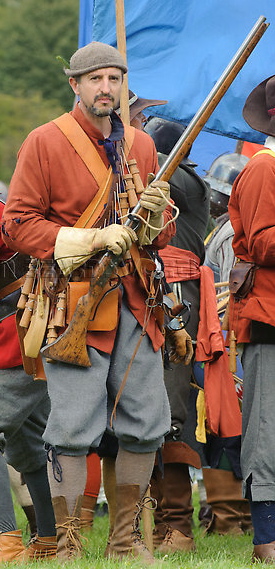
Part two of my basic guide for those of us new to 1640s clothes, this time, the soldiers, from inside out:

A COLLAR or FALLING BAND is worn with shirts, not part of the shirt, but a separate item. In this period it is a rectangle of linen, long enough to go around the neck of the wearer and varies from a hands width to about 20cm deep. The top long edge is gathered into sewn darts, matching the length to your neck measurement and shaping the band. A second rectangle forms the neckband. One edge is turned over and sewn to the underside of the collar’s top edge. Bandstrings are sewn to the ends. The collar’s band sits inside the shirt’s neckband; the collar itself lies outside any jacket. Both shirt and collar are fastened with ties or laces. For common soldiers a tied length of linen tucked into the coat’s standing collar can also be worn
A MONTERO is a round peaked cap made of segments of woollen cloth with a skirt running around the edge that can either fold down for protection in bad weather or up for a stylish peak.
Part Two: Men*
The basic undergarment for all men is the SHIRT. It is a T-shaped, knee length garment made of unbleached linen, with a lot of fabric in the body and sleeves, gathered into cuffs for the sleeves and into a neckband for the body. Square pieces of fabric are folded into triangles and inserted under the sleeves to form gussets. White cloth was the prerogative of richer men and dyed fabric far too expensive to waste on shirts. A soldier’s shirt can be of a coarser weave than an officer’s, but they are all basically the same shape. A shirt is cut high to the neck with an upstanding neckband about 2-3cm high. The neck opening should be long enough for the shirt to go over your head and is tied at the top with a single tie or bandstring.

A COLLAR or FALLING BAND is worn with shirts, not part of the shirt, but a separate item. In this period it is a rectangle of linen, long enough to go around the neck of the wearer and varies from a hands width to about 20cm deep. The top long edge is gathered into sewn darts, matching the length to your neck measurement and shaping the band. A second rectangle forms the neckband. One edge is turned over and sewn to the underside of the collar’s top edge. Bandstrings are sewn to the ends. The collar’s band sits inside the shirt’s neckband; the collar itself lies outside any jacket. Both shirt and collar are fastened with ties or laces. For common soldiers a tied length of linen tucked into the coat’s standing collar can also be worn
Over the shirt a DOUBLET, or SOLDIER’S COAT is worn. The coats were made for regiments to common patterns in quantity, so their fit was not exact. As far as is known, they were made of wool. The simplest style is a loose-fitting garment with body and tabs cut in one piece and with seams sewn only from neck to lower rib-height. Overall length of doublets is to the hip, not the thighs like jackets worn today. The upper body section may end above the modern waistline.
Soldier’s coats were lined or unlined, depending on how much money a Colonel was prepared to spend, but doublets were generally higher quality items and would be lined and tailored to fit and time was taken to finish them properly. Sleeves are close fitting, sometimes with turned-back cuffs and wings over the sleeve tops. Collars are high, stiffened with layers of canvas or pasteboard. For high-waisted styles, you need matching breeches that are longer in the crotch. Coats are fastened down the front with several closely spaced buttons, a dozen at least on a soldier’s coat, more for a doublet. They should be shaped like a ball and shanked but can be made of cloth, pewter or wooden beads wrapped with thread. Cloth buttons are more comfortable on a soldier’s coat if you are going to wear armour over the top.
BREECHES are made from wool cloth, using a limited colour range; what were known as sadd colours: brown, grey, dull green etc., unless you are in a regiment where the colonel paid for breeches in his chosen colour. Style depended on class and geography, unless issued by the regiment. Soldiers from country areas far from the cities, London or Oxford perhaps, wore an old-fashioned shape, full and baggy, button flies and fastened below the knee with ties, or buttons. This earlier style of breeches was often held up by hooks on the waistband that located in eyes on the matching doublet’s inner lining. In fact it can be argued that one of the main reasons for wearing a doublet was to keep your breeches up, although during the war many of these kinds of nicety were quickly forgotten.
A more modern style, worn by townsmen and possibly copied for regimentally supplied breeches, has narrower legs, but is still quite saggy. The legs can be buttoned or left unfastened (unconfined) and possibly tapered in below the knee. Both styles may have pockets in the side seams at the hip. Surviving pockets from the period are simple leather bags, though linen works just as well.
HOSE are worn to just around the knee. A contemporary pattern describes a knee high stocking, turned down over a tied garter. You can buy or (get someone to) knit your own woollen hose. A good modern substitute is plain woollen tights or unribbed knitted stockings in any of the drab colours mentioned in the introduction. Shaped linen or cloth hose are also worn. Hose should be held up by GARTERS, either strips of cloth, or knitted.
Low-heeled LATCHET SHOES were worn by most common people and issued to soldiers in the wars, although mounted officers and cavalry troopers wear boots. A closed shoe or ankle-boot referred to as a STARTUP can also be worn as a more protective alternative. No clear evidence has been shown for their issue by armies in Britain during this period, though they were common for rural folk so they can’t be ruled out for soldiers.
Men of all ages kept their heads covered almost all the time. HATS or CAPS were doffed when you met anyone of higher social status or rank or were being polite. For the battlefield, headgear is determined by your fighting role. Pikemen wear morion helmets and musketeers a hat, cap or bonnet. The simplest is the MONMOUTH CAP, a style of knitted woollen cap, heavily felted. It may have been a fairly high conical shape with or without a brim round the edge.
Knitted and felted BLUE BONNETS are similarly made, but are mainly a Scottish item and should only be worn by Scots units and some northern regiments.
Broad-brimmed HATS are also worn, either made from blocked and felted wool/fur or leather.
To summarise, a soldier’s basic costume, regardless of the fighting arm chosen or the Army that you join, consists of a SHIRT, a pair of BREECHES, a COAT (or DOUBLET), HOSE, SHOES and a HAT. The coat or jacket will be of a colour and cut chosen by the colonel who raised the original Civil War regiment. Sometimes, this applies also to breeches and, occasionally hats. Your regiment will provide relevant details. Shoes, hose and hats can be bought from traders. Some soldiers carry sausage shaped SNAPSACKS, worn across the back from shoulder to hip with a strap diagonally across the chest. CLOAKS or a length of ragged wool or leather for use as a CAPE in the rain may be worn.
*Men can be taken to mean men or women dressed as men. This is an equal opportunities blog!
Photos courtesy of John Beardsworth, Rusty Aldwinckle and Alan Mackinnon
Friday, 9 December 2011
Early Doublet in The Museum of London
Recently I've been visiting the costume department in the Museum of London and have been lucky enough to look closely at a doublet in their collection. It's a bit earlier than our period, but most of the construction techniques in the garment were still being used in the 1640s. Also, because the doublet is in such bad repair, a lot of the internal "workings" are visible which make this such an interesting study. I'm afraid some of this is a bit dry, but I'm reproducing my full report here with a lot of close up shots that you may find interesting.
Thanks to Hilary Davidson at the Museum for help, advice and permission to use the photos.
Anyway, here's the report:
At the lower edge of the garment are a number of square, or nearly square (10-11?) tabs. These run all the way around the waist and are constructed of a different kind of brown wool cloth to the body of the doublet. This is a thick felted fabric with no discernable weave and at least two slightly different browns can be seen on separate tabs, suggesting that this fabric was not selected for the doublet but taken from off cuts (cabbage) of previous tailoring jobs, possibly common coats for lower class customers. The tabs were wrapped in the covering silk, although only on the front, as an edge of about 1cm is visible on the reverse side, tacked down with large running stitches.
Thanks to Hilary Davidson at the Museum for help, advice and permission to use the photos.
Anyway, here's the report:
Catalogue entry:
A7577. 1601-1626; Silk; L 515mm; W (shoulders) 510mm; L (sleeve at
back) 660mm. Doublet, black silk cut velvet, time of Shakespeare, worn
by a member of the Isham family (and father of wearer of A7576).
Hooks on the inside waistband date it to the early C17 as before then
eyelets were used to attach points of the hose.
[see also 33.182]
Introduction
The doublet was worn by a member of the Isham (pron. eye-sham) family, a prominent Northamptonshire family. John Isham (1582-1651) was made 1st Baronet Lamport in 1627 and was succeeded by his son Justinian (1610-1675). Either could have been the wearer of this doublet, which is well made of expensive materials, at least those on show on the outside of the garment and of the fashion current for 1625-30. The style is very similar (although without the braid) to that worn by William Herbert 3rd Earl of Pembroke in an undated portrait by Daniel Mytens (Herbert died 1630) and quite similar to the doublet worn by King Charles in his Mytens portrait of 1629. Although Charles’ doublet has slashed sleeves and 2 visible front slashes on the body, which this garment doesn’t have, the waist is of a similar position to this doublet and the tabs of a comparable size. After this time, the waist moved up the body and the tabs became larger. Charles’ also has ribbon bows and points around the waist in the position indicated by the eyelet holes on the front tabs of this doublet.
Stylistically the doublet is also closely related to the Cotton Doublet in the V&A which is dated c1618, although the V&A example has no metal eyelets, these could have been added to the doublet at a later date. I feel that this garment in style and construction is probably most likely to have been made at the latter end of the date given in the catalogue entry.
Description
The doublet is much degraded but as such shows a wealth of constructional detail that would otherwise be hidden in a finished garment. The body seems to be made of a black silk outer layer, covering a darkish brown melton wool twill fabric (1:1 or 2:1 weave).
Much of the black silk has now gone, the remainder is held in several places by some crude over-sewing (couching) in a brown thread. Where the silk is best preserved, on the lower back for instance and the sleeve, a fine pattern of leaves and scrolls is visible.
This is over a coarse linen interlining which is tacked to the wool using large running stitches in undyed linen thread. Inside the interlining is a layer of possibly wool shoddy/carded wool fleece padding which is covered and quilted by what was originally pink silk taffeta. Some of the pink thread used in the quilting is visible through the threadbare patches and where the collar is detatched from the body.
The collar appears to be made of four layers of thick canvas, one piece folded and sandwiched between two others (as 2 edges and a fold are visible), basted together with undyed linen thread, covered with the same black silk as the body and lined with crimson silk. The lining is still present, though the black silk has almost completely disappeared from the top layer of the collar. There would appear to have been no wool beneath the silk on the collar. There are 3 buttons (see below) on the left hand side of the collar. These would have located into 3 thread worked loops on the right.
The front of the doublet is closed with buttons and buttonholes. 34 worked buttonholes run down the left side to match the buttons on the right. The buttonholes are worked in black thread on the edge of the doublet with a bar on the inner edge and appear to be on a flap formed above the quilted inner. This makes it easier to do up the buttons whilst ensuring the quilting meets in the middle and easier to work the holes with thread. The buttons appear to be thread wrapped with black thread and then partially covered with silver gilt thread in a basket weave pattern.
Some of the buttons appear to be later reproductions. The sequence of buttons is as follows, from the top down, O represents originals, R replacements and G stands for a gap:
OOLLOOOOOOOGOGOGGGGOOOOOGGOOGOGGGRR
Two small flaps, possibly in linen lining canvas, covered with the pink silk are attached inside the lining, low down, level with the highest point of the waistband. They each have a single worked eyelet hole and if tied with a lace before buttoning, would take the tension caused by a larger waistline, which might cause the lower buttons to pop open.
The top of the armhole sleeves are capped with wings, though they are slashed in several places, or maybe made from several smaller finished tabs, edged with silver gilt braid, the lines of braid running away from the seam. The sleeves are of a 2-piece construction and are open at the lower seam to a length of six inches, fastened with 9 buttons and buttonholes. The internal workings of the sleeve buttonholes are not as neat as the visible stitches.
There are scraps of what appear to be a similar silk to that of the lining which indicate that the tabs were originally faced on the inside with silk and beneath that a strip of linen, presumably from the interlining protrudes down about an inch from the waistline. Through the first 2 tabs from the front at least there are worked eyelet holes, 3 on the first tab and beginning from the second tab on each side a strip of silk taffeta, covering a stiffer material, perhaps the same canvas as the collar, with metal eyelets attached runs around the inside of the waistline.This is to attach the doublet to matching hooks on the waist of a pair of breeches. These eyelets where visible are spaced every 2 or 3 inches. The waistline has no loops for a belt which was often the case if a sword was worn with a doublet.
Subscribe to:
Posts (Atom)